


.svg)
Sensitive Data Classification & Management
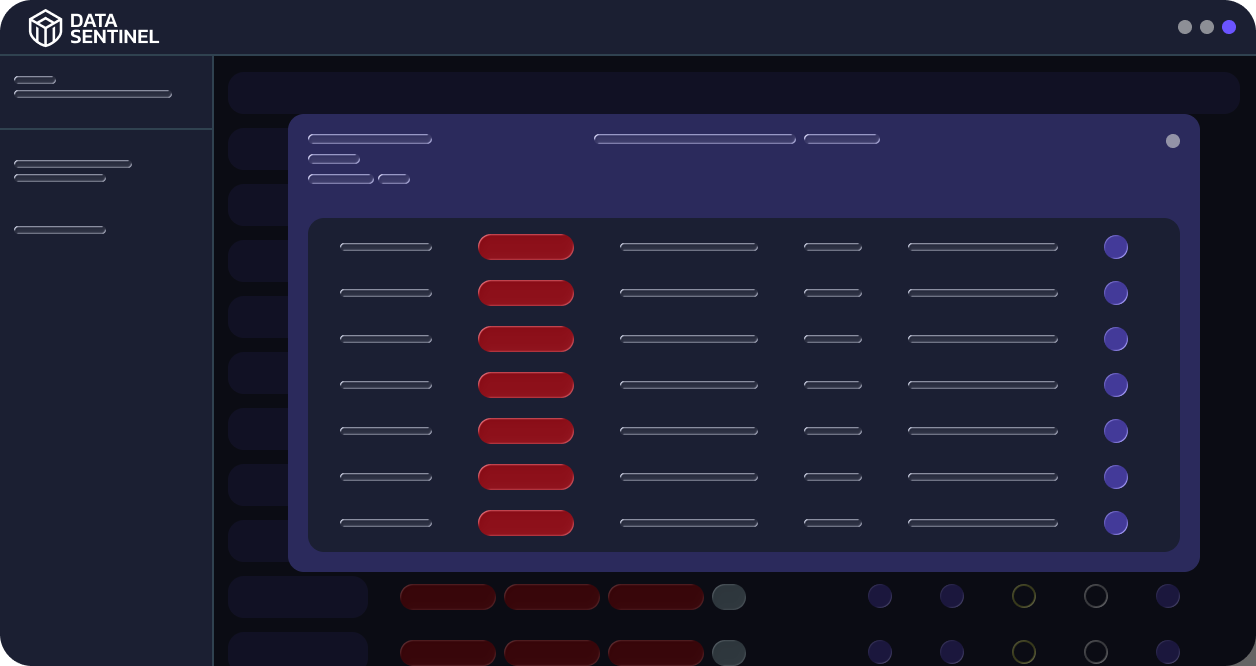
Identify and control sensitive data such as PII, PHI, and financial information, ensuring it’s protected, governed, and handled correctly. Data Sentinel gives you real-time visibility into your sensitive data risk measured financially so you can take action before exposure becomes a breach.

$8.19m
Avg. US Data Breach Cost
$333
Cost Per Record Breached
$?
Impact Of Reputation Damage
36%
Improved Customer Retention
Sensitive data is your organization’s greatest asset and its greatest liability. Personal information, health records, financial data, trade secrets, and intellectual property are scattered across hundreds of systems, formats, and locations; and every unprotected instance represents regulatory exposure, financial risk, and reputational threat.
Data Sentinel’s Sensitive Data Classification & Management solution goes far beyond basic discovery. Our AI-powered engine classifies sensitive data with 98.5% accuracy, tags it with rich contextual metadata, and continuously monitors its movement and exposure across your entire data environment. You don’t just know what sensitive data you have you know where it is, who can access it, whether it’s within policy, and exactly what your financial exposure is if it were breached.

Frequently asked questions
What is a data trust platform?
How do you prepare data for AI safely?
What is AI data governance and why does it matter?
How is Data Sentinel different from traditional data governance tools?
Does Data Sentinel move or store our data externally?
How does Data Sentinel help with data privacy compliance (GDPR, CCPA, HIPAA)?
What is data discovery and classification?
How do you reduce data risk and exposure across enterprise systems?
- What types of sensitive data can Data Sentinel classify? Data Sentinel classifies all standard sensitive data categories including PII (personally identifiable information), PHI (protected health information), PCI (payment card industry data), financial records, intellectual property, trade secrets, and HR data. The classification engine is also fully customizable, so you can teach it to recognize any data type that is uniquely sensitive to your organization.
- How does Data Sentinel calculate the financial risk of sensitive data? Data Sentinel uses a proprietary risk algorithm that measures the financial exposure of your sensitive data holdings in real time. The calculation factors in data volume, sensitivity classification, applicable regulations and their penalty structures, access patterns, and the current state of policy compliance. Risk is scored at the data source and system level and can be tracked over time.
- What automated remediation actions can Data Sentinel take? When sensitive data is found outside of policy, Data Sentinel can trigger several automated actions including dynamic data masking, data encryption, record quarantining (isolation for investigation), nulling/deletion, and substitution. Remediation rules are fully configurable to match your organization’s policies and workflows.
- Can Data Sentinel monitor sensitive data across both cloud and on-premises environments? Yes. Data Sentinel is cloud-native technology that can be deployed on any containerized platform, including on-premises and multi-cloud environments. The platform connects to over 250 data source types and provides unified sensitive data visibility regardless of where your data lives.
- How does sensitive data management support AI governance? As organizations feed data into AI systems, it is critical to ensure that sensitive, regulated, or biased data does not enter AI training pipelines or inference workflows without proper controls. Data Sentinel classifies and tags sensitive data at both enterprise and departmental levels, enabling you to enforce policies that govern what data can and cannot be exposed to AI models.
- How quickly can Data Sentinel detect and respond to sensitive data policy violations? Data Sentinel operates in near real time. When the platform discovers sensitive data that is outside of policy or in a non-compliant state, it triggers automated remediation actions and alerts immediately. The speed of detection depends on your scanning configuration — continuous monitoring provides the fastest response times.
Know Your Risk. Protect What Matters.

AI-Powered Sensitive Data Classification
Classify PII, PHI, PCI, trade secrets, intellectual property, HR data, and any custom sensitivity categories you define. Data Sentinel’s deep learning engine interprets data in context not just keywords delivering enterprise-grade accuracy at scale.

Real-Time Financial Risk Scoring
Understand the dollar value of your data risk using Data Sentinel’s industry-first risk algorithm. Financial exposure is calculated at the data source and system level, measured against current applicable laws and regulations, and tracked over time to show the impact of your remediation strategies.

Automated Policy Enforcement & Remediation
Define your data handling policies and let Data Sentinel enforce them automatically. When sensitive data is found outside of policy, the platform triggers remediation workflows including dynamic data masking, encryption, quarantining, or deletion reducing risk in near real time.

Continuous Monitoring & Alerting
Sensitive data doesn’t stay put. Data Sentinel continuously monitors data movement, access patterns, and policy compliance across all systems. When data moves outside of policy or new sensitive data appears, the platform alerts your data stewards and can initiate automated response.

Cross-Format, Cross-Platform Coverage
Sensitive data hides everywhere in databases, spreadsheets, documents, emails, PDFs, images, and cloud storage. Data Sentinel scans structured, unstructured, and semi-structured data across cloud, on-premises, and hybrid environments.

GRC Integration & Executive Reporting
Integrate Data Sentinel’s sensitive data risk intelligence directly into your enterprise GRC platform. Add a powerful new dimension of data-driven risk to your overall company risk profile, with dashboards and reports designed for board-level visibility.
From Visibility to Control
Most organizations know they have sensitive data scattered across their systems. The challenge is knowing exactly what, exactly where, and exactly how exposed it is in real time, at scale, and with the granularity needed to take action.
Data Sentinel transforms sensitive data management from a manual, point-in-time exercise into a continuous, automated, and financially quantified discipline. Whether you’re preparing for an audit, responding to a regulatory inquiry, managing breach risk, or building a data-driven culture of trust, Data Sentinel gives you the intelligence and automation to protect what matters most.
How trustworthy is your data? Book a demo today to see how Data Sentinel can help you.
BOOK a demo
Oops! Something went wrong while submitting the form.
About Data Sentinel
Protect, Comply, Govern, and Grow with Trusted Data
Data Sentinel helps enterprises turn fragmented, high-risk data into a trusted, controlled asset. Its unified platform combines data discovery, governance, privacy, and quality, giving organizations the visibility and control needed to reduce risk, meet compliance requirements, and safely deploy AI at scale.
Built to operate directly inside your environment, Data Sentinel ensures sensitive data never needs to be moved, delivering policy-driven enforcement, continuous monitoring, and true data control where it matters most.
Built to operate directly inside your environment, Data Sentinel ensures sensitive data never needs to be moved, delivering policy-driven enforcement, continuous monitoring, and true data control where it matters most.
OUR HAPPY CLIENTS
- Something went wrong